Quiet drones at last: MIT invention makes drones significantly quieter

Researchers at the Massachusetts Institute of Technology (MIT) have developed new low-noise propellers that make today’s multirotor drones quieter. What’s behind it?
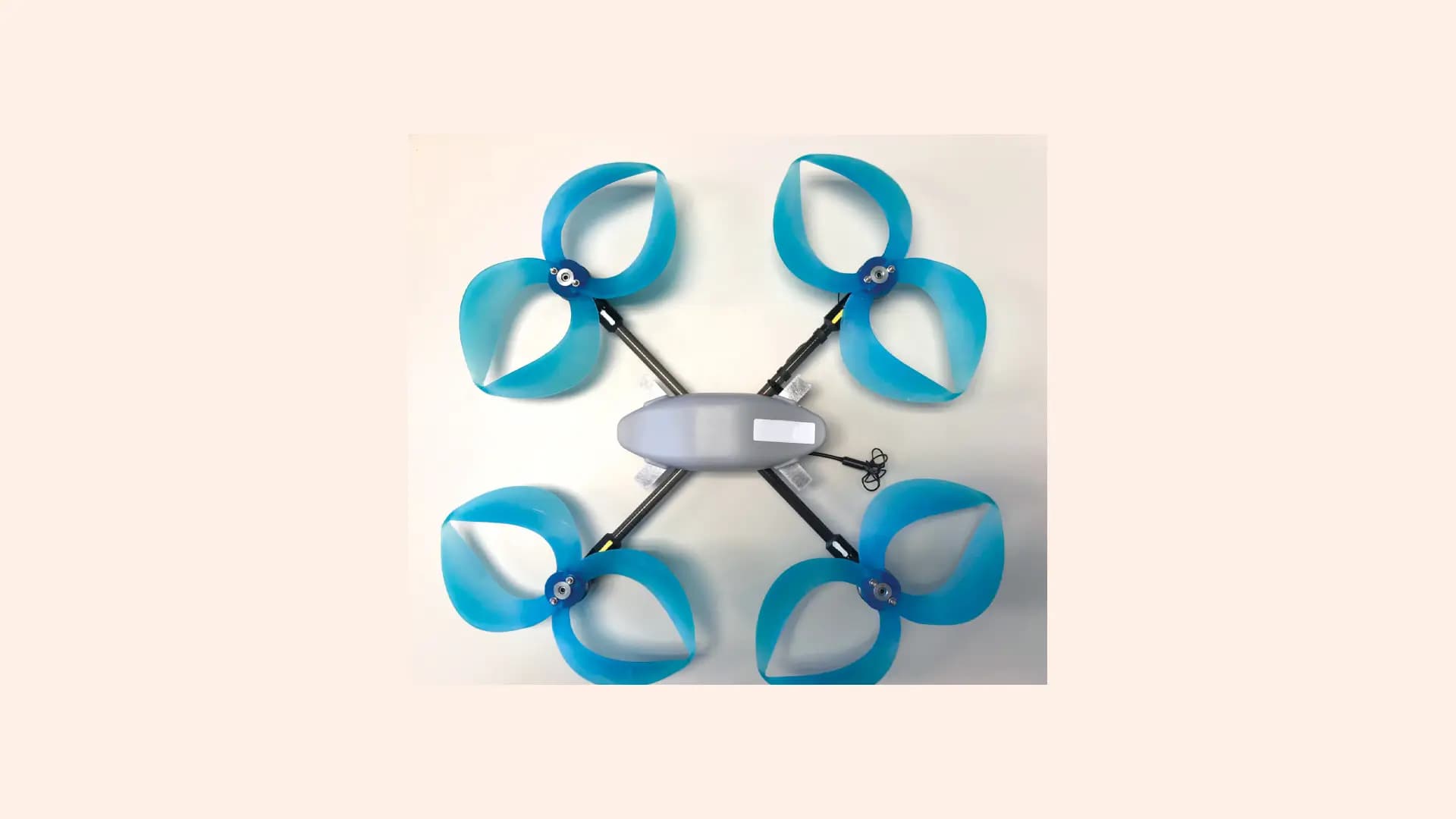
A team at MIT Lincoln Laboratory says it has developed a closed propeller design that can significantly reduce drone noise. The configuration, patented by the facility, makes the propellers sound almost like a rushing breeze instead of a high-pitched drone, without losing thrust.
MIT’s quieter toroidal propellers, named for their donut shape, consist of two blades that converge so that the tip of one blade extends into the other. This closed structure minimises the flow effects of vortices (i.e. vortex) at the blade tips and increases the overall stiffness of the propeller. The result is a significantly reduced acoustic profile of the propeller (see PDF).
The researchers report that when they tested prototypes of the toroidal propellers on DJI drones, they found comparable thrusts to conventional propellers with similar performance. But the reduced noise level of the drones equipped with toroidal propellers meant that they were only half as disturbing as a normal drone. Or to put it another way, the drone sounded like it was twice as far away.
Dr Thomas Sebastian, a senior member of the Structural and Thermal-Fluids Engineering Group at Lincoln Lab, explains that the design of these quiet propellers was derived from experimental aircraft from the early 1900s and those in use during World War II. „There were some designs that were essentially ring vanes. So I wondered what it would look like if you took a ring wing and made it into a propeller.“
After some experimentation, the researchers focused on a design that would win the R&D 100 Award in 2022. They also found that the propellers could be 3D printed and adapted to a range of models so that they could be used as spare parts for current drones.
The next big step in modern drones?
Quiet and silent propellers are important because noise from drones can be a major problem in ongoing operations, especially when they are used near people or in cities. The European Aviation Safety Agency (EASA) has even published guidelines explaining how UAS manufacturers and government agencies can measure drone noise levels to ensure they do not cause a nuisance to people and wildlife.
If the technology presented here proves to be efficient in further tests and becomes established in practice, we could possibly be looking forward to significantly quieter drones in the near future.
We continue to keep a close eye on the issue.
Was this article helpful?
Subscribe to our newsletter
Subscribe to our newsletter and get fresh articles on a regular basis.